June 28, 2009

Upcoming Posts – July

Flickr photo by Zoha_n

Flickr photo by Zoha_n

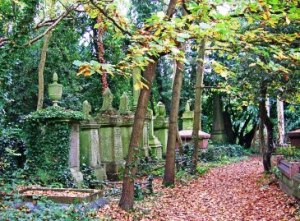
A few months back, I discussed the issue of cemetery book publishing with an editor. She was very informative but gently pointed out that cemetery books do have the misfortune of being seen as regional.

“Regional” translates to a smaller market, smaller sales and smaller profits for the publisher, unless it’s a well-known topic and the author can provide a ready venue of potential readers.

Considering the on-going upheaval in the publishing industry and the current market situation, this is a fair statement.

However, it means that for those cemetery books already out there, marketing is skimpy and this is a shame. So I’ve decided to begin adding the occasional book review to my blog along with author interviews (whenever possible).

July’s postings will focus on two categories – reference and general interest.

Article One:

Good reference books are integral to any research writing project and over the past two years, I’ve come to rely heavily on three specific gems. One supplies direct support, another general direction while the third, is a source of inspiration for where I’d like to go next. Check in mid-month to find out more – the titles might surprise you!

Article Two:

Old Canadian Cemeteries: Places of Memory by Jane Irwin. This book is the international equivalent of the one I have for future inspiration, but with more photos. A beautiful book well worth poring over on a quiet day. The pictures alone did it for me.

And of course, I will be sure to post whatever interesting photo finds I see in my travels around the local cemeteries here in the Pacific NW.

June 25, 2009

Soapy Smith: Con Artist Extraordinaire

Soapy Smith

Photo courtesy of Sabine Ludwig

Soapy Smith is one of the most well-known and amoral criminal masterminds of 19th century America. An accomplished con artist from the age of 19, he eventually rose to command a gang network of criminal activity through a combination of wit, charm, and weapons.

Jefferson Randall Smith II was born November 2, 1860 into a wealthy, educated Southern family. His grandfather was a plantation owner and his father was a lawyer. However, the after-effects of the Civil War broke the family financially, causing them to move to Texas for a fresh start.

At the age of 19, Smith got his own fresh start in Forth Worth when he began his career as a con man known for his soap shell game and the 3-card monte (which is simply another version of the shell game).

Shell games can be traced back to the Middle Ages where it was often played with thimbles. In the 19th century, it was a popular county fair distraction played with either peas and three shells or balls and cups. The object of the game was to bet where the pea had been hidden. If the guess was correct, the person would win double the money initially put down.

However, due to the expert sleight of hand ability of most shell game players, the bet placer would never win.

Note: Keep in mind that sleight of hand ability shouldn’t always be considered bad. In 2006, David Copperfield confused a would-be thief by claiming he had no wallet on him at the time he was being mugged. Sleight of hand allowed Copperfield to hide his wallet elsewhere.

The same scenario plays out with 3-card monte.

Three cards are placed face-down and the person placing the bet is asked to find the winning card after they’ve been shuffled. In the rare event that a bet placer actually chooses correctly, quick sleight of hand allows the dealer to slide another, losing card under the winner by using a “throw” technique or a Mexican turnover trick.

Smith took the shell game a few steps further by wrapping $1 to $100 bills around several bars of soap and placing them alongside of regular soap bars. The customer put down $1 for a chance to guess where the currency- wrapped soap was located. However, Smith kept track of which bars were wrapped and ensured his accompanying gang members always “won” these, thus encouraging more people to play.

Hence the nickname, Soapy Smith.

But while con games kept food on the table, Soapy was always attuned to new opportunities that might make him some quick money. The instability found throughout many 19th century frontier towns certainly assisted him in this goal.

In Denver, Colorado one business venture included a ‘discount’ train ticket sales office. The money would be taken but strangely enough, the ticketmaster was never around to dispense the purchased tickets. Another scam included his acting as sheriff to help ‘close down’ local gambling joints and brothels. Patrons who had lost large sums of money in his businesses were ‘arrested’ and then released if they went quietly home without attempting to reclaim their losses. Unfortunately, this easy way of money didn’t last too long after it was discovered Smith was rigging elections. He was asked to leave town sooner rather than later.

Smith’s final hurrah was in Skagway, Alaska from 1897-1898 .

At this time, the Klondike Gold Rush was in full swing and seeing boundless opportunities for easy money in another frontier town, Smith moved north and began relieving miners of their heavy gold-carrying burdens.

A telegraph office (with wires extending only to the wall) was built. Miners stood in line waiting their turn to send a message home about their earnings while members of Smith’s gang worked their shell games and 3-card monte cons.

When one vigilante crew was finally established with the goal of cleaning up crime (and ideally, getting rid of Soapy), Smith simply formed his own gang to go after the vigilante crew.

During the Spanish-American war, Smith organized his own Skagway Military Company as potential fighters, even obtaining President McKinley’s recognition of his organizational efforts. Never one to leave a potential income stone unturned. Smith turned this presidential recognition to his advantage by using it to shore up his political control over Skagway.

But all good things must come to an end.

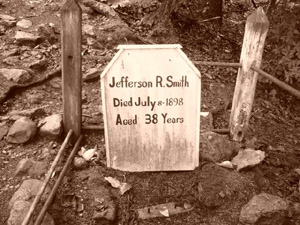
On July 8, 1898, the day after Soapy’s crew swindled $2,700 from a Klondike Miner, vigilantes met with him to discuss repayment terms. An argument broke out and led to a gunfight and Smith was shot and killed.

His grave remains a highlight for Skagway tourists


Other Resources:

• YouTube Video: How to perform a Mexican Turnover

• YouTube Video: How to perform a card throw

• HistoryNet.com: Soapy Smith, Con Man’s Empire

• Legends of America: Soapy Smith, Bunko Man of America

Google Timeline of Soapy Smith’s life

June 18, 2009

Just a quick note…

Currently, I’m hard at work researching and photographing various cemeteries here in the Pacific NW for my Stones & Bones… project and one of the most enjoyable aspects is coming across a highly detailed carving. This example was found at the coal miners’ cemetery in Newcastle, WA.

While its representative group is familiar enough (The Knights of Pythias), I’m not seeing too many examples of this level of detail.

At least not yet.

I still have a few more places to visit and am looking forward to sharing what I find.

OverviewA      Close upA

June 16, 2009

Denys Finch-Hatton: Last of the Edwardians

Aviation pioneer and big game safari leader, Denys Finch Hatton was the quintessential Edwardian gentleman living in the romanticized era of large hats, garden parties and African safaris that occurred between Queen Victoria’s death and World War I.

Finch-Hatton is best remembered by his portrayal in Isak Dinesen’s book, Out of Africa, and by his connection with Beryl Markham, the first woman to fly east to west across the Atlantic Ocean. An aristocrat (his father was the 13th earl of Winchilsea) and educated at all the right schools (Eton and Brasenose College, Oxford) Finch-Hatton moved to British East Africa at the age of 24 and began indulging his love of big game hunting.

Later on, he would parley this experience into acting as a professional guide for wealthy big game hunters.

Yet safaris weren’t the only notable adventures to be had. Aviation was finally starting to come into its own after WWI and by 1929, it was estimated that out of every 100 airplanes owned in Great Britain, the majority of them were DeHavilland Gypsy Moths.

Finch-Hatton’s Gypsy Moth came in handy not only for scouting out potential trips for his clients but for also seeing the African landscape in a completely new way. 

And then tragedy struck.

On May 14, 1931, Finch Hatton took off from Voi airport (outside of Nairobi) but never made it to his destination. The plane unexpectedly stalled, plunged to the ground and burst into flames. His body was later recovered for burial in his beloved Ngong Hills at a site marked with an obelisk and a simple brass plaque marker.

Obelisk

In April, 2009, Sabine Ludwig journeyed to visit both his grave and Karen Blixen’s house in Nairobi, Kenya

“After traveling fourteen hours on the night train from Mombasa, we arrived in Nairobi the next morning at a beautiful train station that seemed as though it had been frozen in time since the early 1900s.

Nairobi is supposed to be the most dangerous city in Africa since the fighting  started in January, and houses are now equipped with at least two dogs, a security service and high electrical fences. However, Nairobi city center was a pleasant place to visit and the local people all very helpful. Of course we visited the house where Karen Blixen lived from 1914 to 1931. It’s a beautiful museum located in the Nairobi suburbs.

Blixen house 2

During our visit, we decided to take a taxi up into the Ngong Hills to look for the grave of Denys George Finch-Hatton Unfortunately, the Ngong Hills become dangerous after night fall and we left the Karen Blixen museum later than planned.

The poor taxi driver.

Six miles of badly rutted dirt roads and one sunset later, we arrived at the obelisk where we managed to shoot a few photos before turning around for our long bone-rattling drive back to our guesthouse home, content with having seen this special part of Kenyan history.”

More Resources:

YouTube Video Clip: Flight Over Africa

New York Times: In Search of Karen Blixen’s Kenya

St. Petersburg Times: Visiting Author’s Africa Revives Area’s Long-Ago Era

New York Times Book Review: Too Close to the Sun: The Life of Denys Finch Hatton

May 24, 2009

Soquel Cemetery: Generations of Metaphors

mapdata

Soquel, California (pronounced “so-kell”) is a quiet town off the Northern California coastline, rooted within Spanish land grants dating back to 1776. Located approximately 70 miles south of San Francisco, most beach tourists driving the winding Highway 1 route to Santa Cruz beach spots rarely give it a second thought. However, those opting for the quieter, redwood tree-lined back roads have an opportunity to see this town first hand.

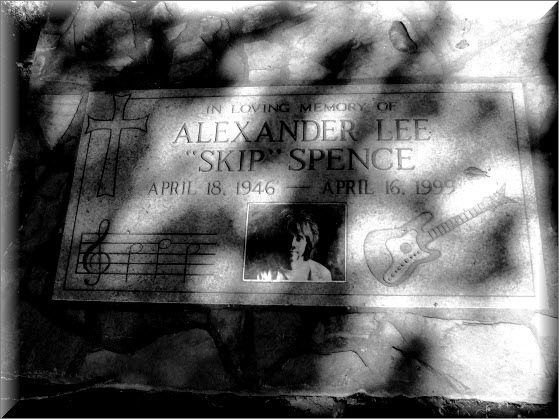
To the left and on the hill from the main four corners is a beautiful New England-styled church. Straight down the street is the unique Porter Memorial Library built in 1912 while to the right, is the Ugly Mug coffee house. But it’s the spot just outside of town at 550 Old San Jose Road that draws the most interest from fans of Skip Spence and genealogists tracing family history.

cemetery sign_SP

Photo by Shelly Peters

Established in 1852, many of Soquel’s original families have now either died out or moved away. However, there are still local residents with direct ties to early pioneer days and Alice Daubenbis is one of them. She traces her roots to the town (and cemetery) founder, John Daubenbiss (her 3rd Gr.- uncle) and Sarah Lard Daubenbiss, the daughter of Fielding and Nancy Lard who traveled west with a 160 wagon train caravan to start their new life in California.

Feilding Lard_SP            Sarah C Lard Daubenbiss (2)

Photos by Shelly Peters

Fielding Lard worked as a guide for the 160-member wagon train coming from Missouri and along the way, he gained a son-in-law, Riley Septimus Moutrey, who played an integral part in the first team sent to rescue the infamous Donner Party.

Another descendant with several generations of family ties is Dick Nutter, currently president of the Soquel Pioneer and Historical Association.

Charles Ryder, (Dick’s Nutter’s 2nd Gr. –Grandfather) endured the harrowing ocean journey around Cape Horn before eventually settling in Soquel. He later married Harriet Kirby who had come west with her siblings to join her father, Gershom Kirby (Dick’s 3rd Gr. –Grandfather). Harriet’s marker can be seen below on the left, but unfortunately, it is uncertain exactly where the stone should be placed due to later years of cemetery neglect. Harriet’s brother, Silas Kirby, served during the Civil War and his stone can be seen on the right. While both markers have suffered the undignified fate of being forgotten, the irony is that the stones have been left remarkably well preserved.

Harriet Ryder - plains traveler              Civil War 2 - brother

However, it’s not just family history links that are seen here. There is also the lost language of flowers.

Below left, Louisa’s headstone is decorated with morning glories to symbolize the Resurrection and roses to also remind us of Paradise’s fragrance. In the middle is Mama’s stone (Elizabeth Conant, b. 1852, d.1901) engraved with calla lilies to signify beauty and marriage along with what appears to be bell flowers, symbols of constancy and gratitude. Below right, is Frank Noble (d. 1858 at 6 months). His stone shows a carved hand with three extended fingers representing the Trinity, reaching from heaven to pluck the rose of innocence.

Louisa     mama     close up 

As the visitor wanders into the newer section, a gradual progression away from floral imagery becomes more apparent. Take Olive Meachen’s memorial (d. 1881) as a starting example. The first carving is an open book signifying the deceased’s name’s registration in the Book of Life.

Open book1

The front shows a dove for purity, holding a sign saying, “Father, I am coming.” The dove is surrounded by ferns for humility and sincerity, roses, evening primroses for eternal love and memory, plus morning glories for the Resurrection. Below these, is a now faded inscription. The left hand column is reserved for naming practicalities while its starkness is relieved by another small bouquet.

Olive-front       Olive-inscription  side show

 Now compare Olive’s stone against the simpler lines for Lola Abbott (b. 1924, d. 1935) and Caroline Lotman (b. 1834, d.1912), whose stones are seen below. As an interesting point for family genealogists, Caroline’s marker has her maiden name, “nee Leonhard,” inscribed, something not typically done on a pioneer wife’s marker.

Lola Abbot           nee tombstone

As the stones become newer, more personalizing appears. A carved wooden Russian plaque with the words, “Oh Lord, Save” in Old Church Slavonic, a tiled patchwork quilt, a boulder marker for Adam Darling

Russian Marker - 2    patchwork quilt   Adam Darlng

…until finally, a set of handprints, forever frozen in time, and a surfboard, complete the circle.

Photo 19     Photo 20

And perhaps this is the most commonly overlooked aspect of Soquel Cemetery – the creative evolution of cemetery metaphor from the early pioneers to modern times.

(c) 2009 by G.E. Anderson


Additional Sources:

- Stories in Stone: A Field Guide to Cemetery Symbolism and Iconography by Douglas Keister

- Capitola Soquel Times

- Capitola, CA historical context overview

- Forest of Nisene Marks: Spanish & Mexican Heritage Sites

- The Donner Party Diaries, by Daniel M. Rosen

- Skip Spence Biography